Note: This feature is accessible only when the Accounting and Inventory software are purchased together. Please refer to the Accounting Software documentation for more details
Once goods are delivered to a customer, the next step is recording the Customer Invoice. In the Sales App, Customer Invoices are linked to Sales Orders (SO) and Goods Issues (GI) to ensure accurate matching (SO → GI → Invoice). Once invoices are approved, receipts from customers can be recorded and tracked.
Purpose of Customer Invoices
Generate invoices for goods sold or services delivered.
Match customer invoices with sales orders and goods issues to ensure accuracy.
Track outstanding receivables and incoming payments effectively.
Maintain a clear audit trail of sales transactions.
Step 1: Create a New Customer Invoice
Open the Invoices tab and click New.
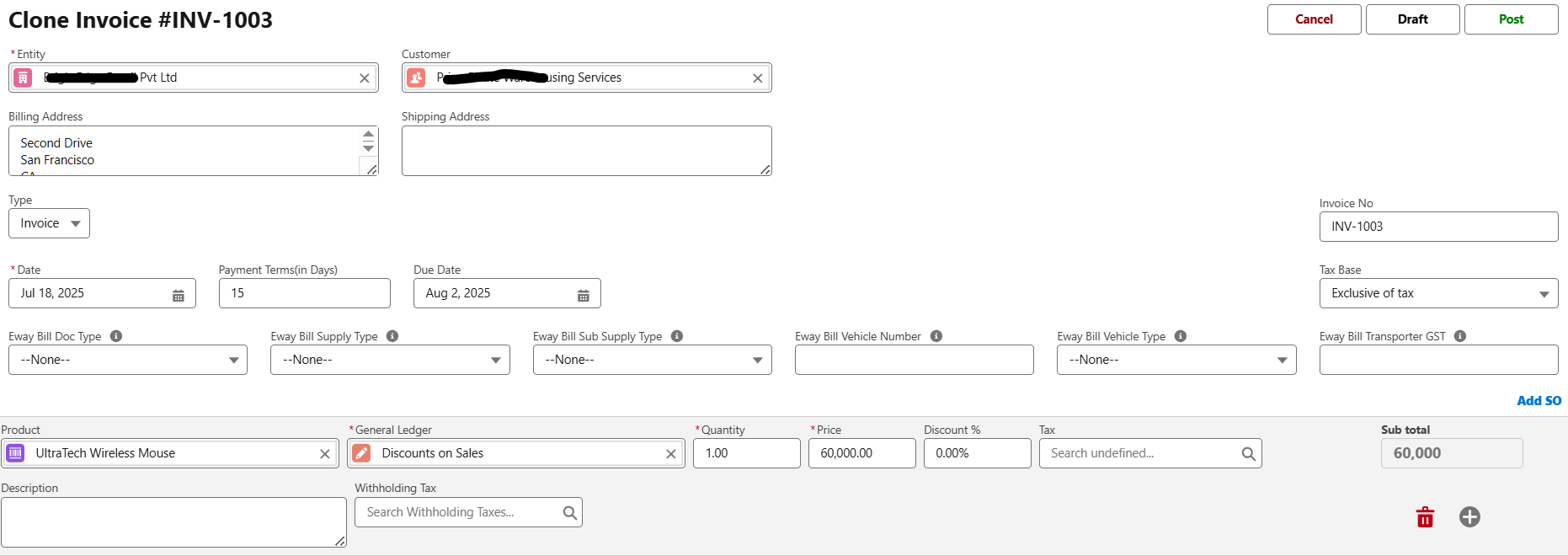
Select the Customer Account.
Link the invoice to an existing Sales Order (recommended).
Verify that quantities and prices from the SO and GI match the invoice.
Enter the following details:
Invoice Number (system-generated or manual).
Invoice Date and Due Date.
Warehouse (from where goods were shipped).
Taxes, Discounts, and Additional Charges if applicable.
Save the invoice.
Step 2: Matching Process
The system validates the invoice against the Sales Order and Goods Issue.
Discrepancies in price or quantity are flagged for review.
Ensures customers are only billed for goods actually ordered and delivered.
Step 3: Recording Customer Receipts
Open the Customer Invoice.
Click New Receipt.

Choose Payment Method (Bank Transfer, Cash, Cheque, Credit Card, etc.).
Enter payment details:
Amount Received (full or partial).
Receipt Date.
Reference Number (transaction ID/cheque no.).
Save the receipt entry.
Step 4: Invoice Lifecycle
Draft – Invoice created but not yet finalized.
Open – Approved and awaiting payment.
Partially Paid – Some amount received, balance pending.
Paid – Fully settled.
Reports & Dashboards
Outstanding Customer Invoices – Invoices pending payment.
Aging Report – Overdue invoices by 30, 60, or 90+ days.
Customer Revenue Report – Total revenue per customer over a given period.
Receipts Dashboard – Track collected vs pending payments and upcoming dues.
Best Practices
Always link invoices to Sales Orders and Goods Issues for accuracy.
Use due dates to follow up on overdue customer payments.
Reconcile receipts regularly with your accounting system.
Monitor customer payment behavior using invoice and receipt data.
Next Step
Now that you’ve learned how to manage Customer Invoices and Receipts, you can explore Sales Reports & Dashboards to gain deeper insights into your revenue cycle.
Was this article helpful?
That’s Great!
Thank you for your feedback
Sorry! We couldn't be helpful
Thank you for your feedback
Feedback sent
We appreciate your effort and will try to fix the article